Fake Marketing Agencies Are Destroying Indian Businesses.
A fake marketing agency in India is not always easy to spot. But the damage they cause is very real. Every week, somewhere in Uttar Pradesh, a small business owner pays an agency between Rs. 15,000 and Rs. 1,50,000. They get a WhatsApp invoice, a few social media posts, maybe a website. Three months later, nothing has changed. No new customers. No visibility on Google. Sometimes, not even a working website they actually own.
This is not bad luck. It is a pattern. And it is happening at a scale that most people in the Indian digital marketing industry will not talk about openly.
But we will.
The website that was never theirs
Explore Indus is a travel and tourism company based in Agra. They offer same day Taj Mahal tours, Golden Triangle packages, and car rentals. A genuine small business with real services and real customers.
At some point, they paid someone to build them a website. That website is live today at exploreindus.com.
Here is what we found when we looked at it:
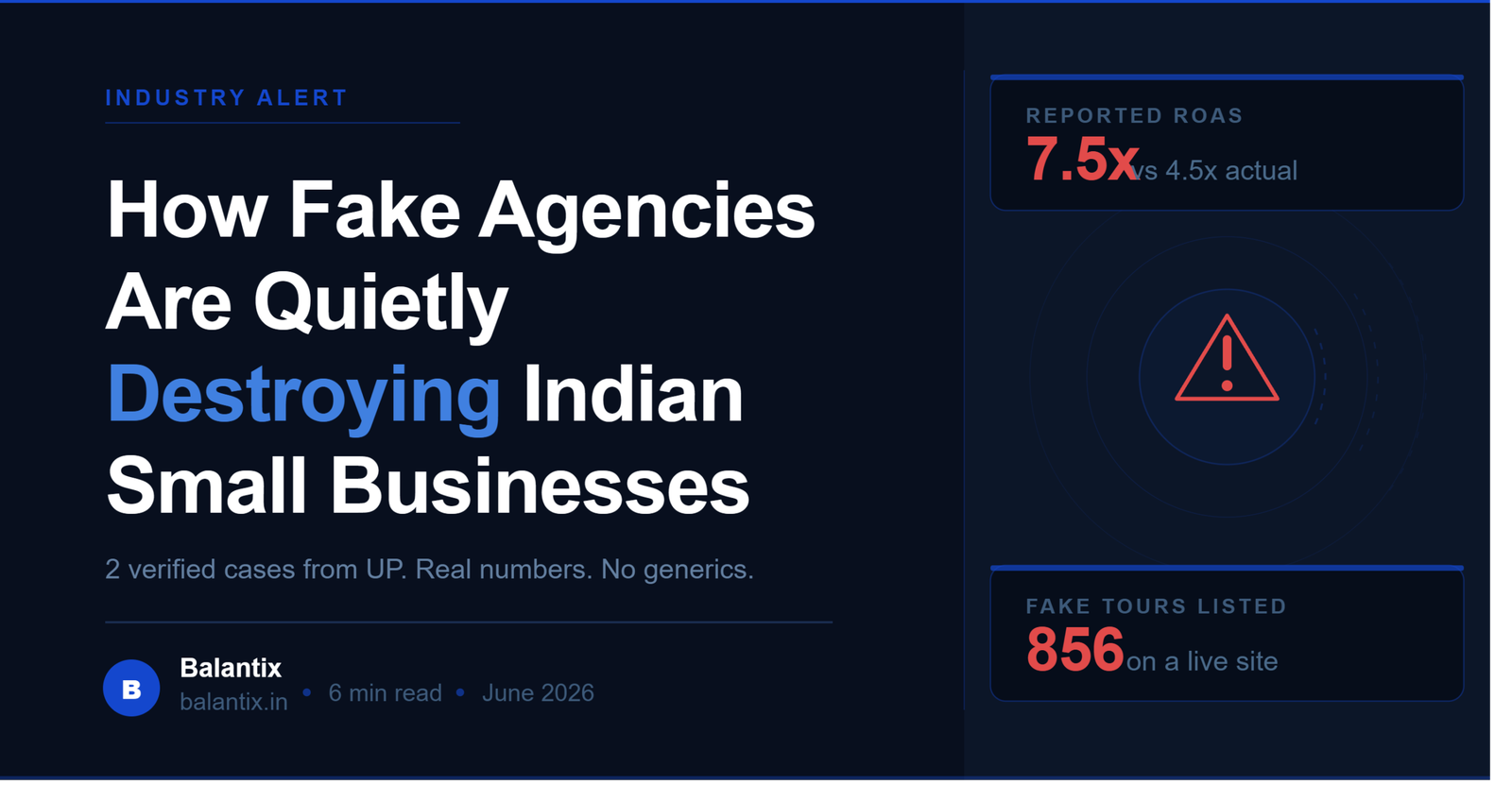
The website claims to have “over 856 guided tours.” A small Agra travel company. 856 guided tours. That number did not come from their business. It came directly from the template the developer downloaded and never bothered to change. The meta description, which is what appears on Google when someone searches for them, reads: “Explore Indus offers Cheap North Travel Holiday India Tours.” The word cheap appears in the very first line of their Google listing. For a business trying to attract international tourists looking for quality experiences near the Taj Mahal, that single word is doing serious damage every single day.
The banner images on the homepage are stock photographs. Not photos of their actual tours, their actual guides, or their actual clients. Generic images that appear on hundreds of other travel websites across India.
There is no structured data. No schema markup that tells Google this is a local business, what their services are, what their hours are, or where they operate from. Google essentially cannot understand what this business does or who it serves.
The developer charged for a website. They delivered a shell. The business owner probably has no idea.
This is not a technical failure. It is a trust failure. Someone presented themselves as capable of building a business asset and delivered a placeholder that actively works against the client.
The performance marketing promise that cost more than it made
The second case involves a D2C brand in Moradabad, U.P India, operating in a competitive product category. They hired a digital marketing agency specifically for performance marketing, meaning paid ads on Meta designed to drive sales.
The agency reported strong numbers. A return on ad spend of 7.5x sounds excellent. The business owner felt confident. The campaigns seemed to be working.
But when we sat down with the actual numbers, a different picture appeared.
The reported 7.5x ROAS was calculated before returns. Before logistics costs. Before the cost of the products themselves being sent out and coming back unsold. When you factor in the actual return rate, the real cost of fulfilment, and the margin per unit sold, the true ROAS was closer to 4.5x. In some months, the campaigns were generating activity without generating profit.
The agency was optimising for purchases. Not for profitable purchases. There is a significant difference, and a genuine performance marketing partner knows that difference from day one.
What made this worse was the discount strategy. To hit volume targets and keep the reported ROAS looking healthy, heavy discounts were being run. This trained the customer base to wait for sales. It eroded the brand’s perceived value. The short term numbers looked good. The long term health of the brand was being quietly damaged.
The business owner was not stupid. They were trusting someone who presented numbers without context.
Why this keeps happening in Tier 2 India
Both of these cases share a common root cause. The businesses involved were operating in cities and markets where there is a shortage of people who can tell the difference between a real digital marketing professional and someone who has watched a few YouTube tutorials and set up a GST number.
In Delhi or Bangalore, a business owner has access to agencies with track records, case studies, and client references they can actually verify. In Agra, Aligarh, Meerut, Lucknow, and most of UP, the market is flooded with individuals and tiny operations who have learned just enough to sound credible in a meeting but not enough to deliver real results.
The tell-tale signs are always there in hindsight.
Guaranteed Page 1 rankings in 30 days. No legitimate SEO professional says this. Rankings take time and depend on competition, domain age, content quality, and dozens of other factors. Anyone who guarantees a position is either lying or planning to use black-hat techniques that will eventually get the site penalised.
Ownership of the website, the ad account, and the domain kept by the agency. This is a serious warning sign. Your website domain, your Google Ads account, and your Meta Business Manager should always be registered in your name or your company’s name. When an agency holds these, leaving them means losing everything they built.
Reports without raw data access. If your agency sends you a PDF report but will not give you access to Google Analytics, Google Search Console, or the actual ad account, they are controlling what you see. Real partners give you access to everything.
Packages that bundle everything for one price with no breakdown. Rs. 25,000 per month for SEO, social media, ads, and a website sounds like a deal. What it usually means is that each service is being done at a level that produces the appearance of activity without producing results. Posting three times a week on Instagram is not social media marketing. Running a Rs. 3,000 ad budget and calling it performance marketing is not performance marketing.
What a Genuine Marketing Agency Actually Does
A real agency starts by understanding what the business needs, not by selling a package. For a travel company in Agra, the priority is appearing on Google when someone searches “same day Agra tour from Delhi” or “Taj Mahal guided tour booking.” That requires setup of local SEO & AEO, Google Business Profile optimization, structured data markup, and content that answers the actual questions tourists are asking.
For a D2C brand running paid ads, the priority is understanding the unit economics before a single rupee is spent. What is the product margin? What is the acceptable cost per acquisition? What is the return rate historically? Without those numbers, any ROAS figure is meaningless.
This is the work that most freelancers and small operators in the UP market are not doing. Not because they are all dishonest, but because many of them simply do not know how.
At Balantix, when we audit a new client, the first thing we look for is whether they actually own their digital assets and whether the work done previously was built to serve them or to serve the person who billed them. In most cases involving businesses from Tier 2 cities in UP, we find at least one of the problems described above. Sometimes both.
Three things to do before hiring any digital marketing agency
Search for the agency’s own website on Google. If a digital marketing agency does not rank for its own name in its own city, that tells you something important about their actual capability.
Ask for client references you can speak to directly, not just testimonials on a website. Call the client. Ask them if the agency delivers reports, gives them account access, and whether they have seen real business results.
Ask who owns the domain, the hosting, the ad accounts, and the social media pages. Get the answer in writing before paying anything.
The businesses that get burned are not careless. They are trusting. The Indian digital marketing industry has a responsibility to those businesses that most operators in the market are not taking seriously.
That needs to change.
FAQ Section
Look for these warning signs: they guarantee Page 1 Google rankings in 30 days, 200 to 300 backlinks. No, previous portfolio. They keep ownership of your website or ad accounts, they show you reports without giving you direct access to analytics, and they cannot show you real business results from past clients, only follower counts or traffic numbers.
ROAS stands for Return on Ad Spend. It measures how much revenue is generated per rupee spent on ads. However, agencies sometimes report ROAS before deducting returns, logistics costs, and product costs. A reported 7.5x ROAS can translate to a real profitability of 4x or less once actual costs are included. Always ask your agency to show net ROAS after returns and fulfilment.
Yes, significantly. Copied templates often contain placeholder content, fake statistics, and generic meta descriptions that damage your Google ranking and confuse potential customers. A website built on someone else’s template without customisation is not a business asset. It is a liability.
You should always retain ownership of your domain name, website hosting account, Google Ads account, Meta Business Manager, Google Analytics property, and Google Search Console. Never allow an agency to register these in their own name.
Yes, Look for agencies that are transparent about their process, give you full access to your accounts, show you real case studies from comparable businesses, and set realistic timelines. Balantix is Aligarh based digital marketing agency in Uttar Pradesh India. Balantix works specifically with small and mid-sized businesses across India and offers structured digital systems built on accountability, not promises.